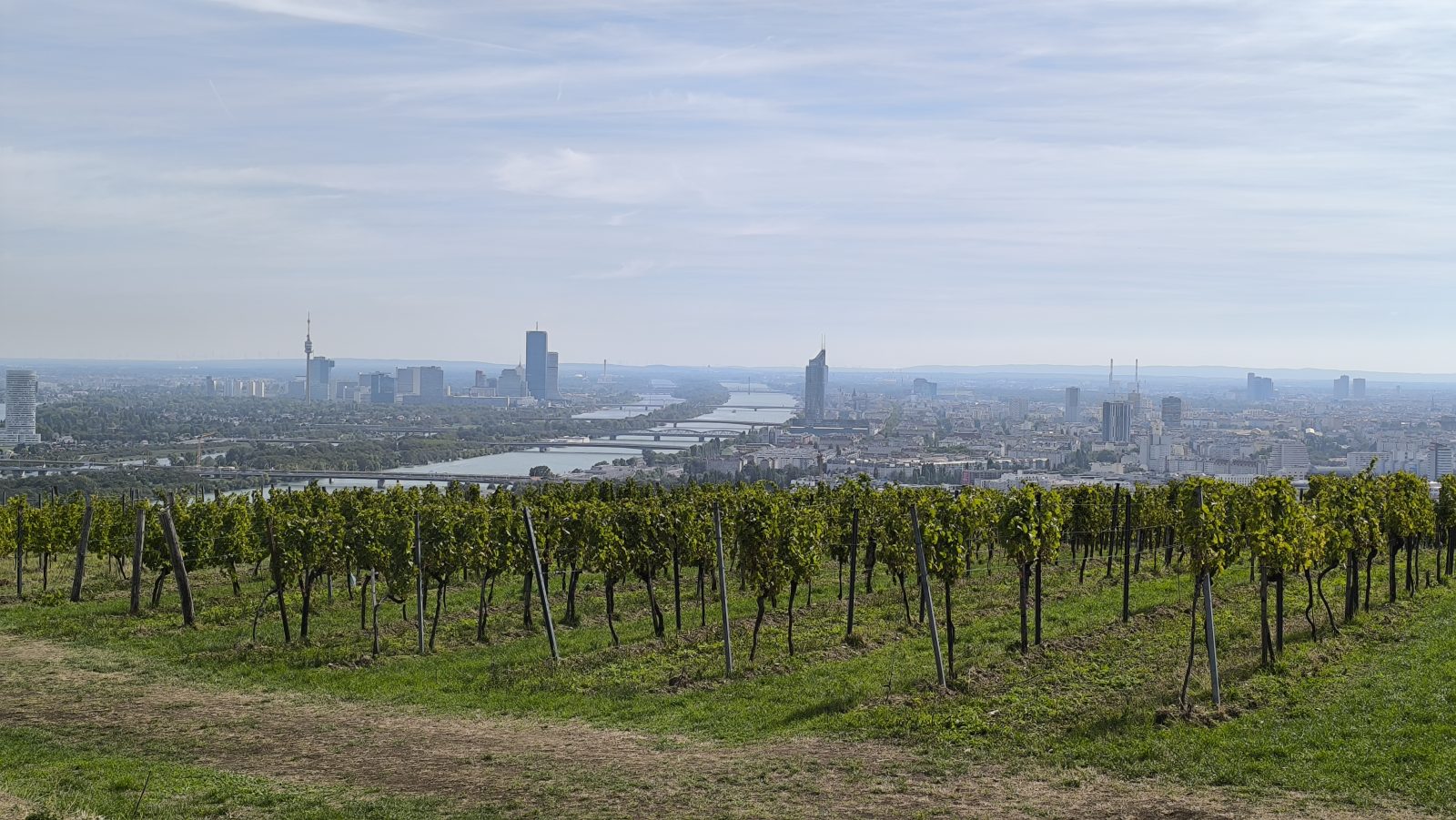
Vines at the tram terminus
Those who take the number 31 tram to Stammersdorf get off surrounded by cellar lanes and vineyards, and they're still within Vienna's city limits. From the Bisamberg, the city lies at the feet of the winemakers. There are hardly any other cities with millions of inhabitants where viticulture plays such a major role. The figures vary depending on the source: Österreich Wein Marketing and Wikipedia cite around 588 hectares, while the city of Vienna speaks of about 700 hectares. Everyone agrees on one point: approximately 400 operations manage these areas.
Three zones, three characters
The north-west is classic Viennese wine country. Here lie Nussdorf, Grinzing, Sievering, Neustift am Walde and Heiligenstadt on the slopes of the Kahlenberg and Nussberg. The Nussberg, with around 150 hectares, is Vienna's prime vineyard. The soils are rich in lime, with Riesling, Grüner Veltliner, Chardonnay and Weißburgunder thriving particularly well.
North of the Danube, at the Bisamberg, Burgundy varieties are grown predominantly, according to Österreich Wein Marketing. Winemakers from Stammersdorf, Strebersdorf and Jedlersdorf work here. Stammersdorf is considered the city's largest contiguous wine-growing area. In the south, in Mauer and Oberlaa, you find darker black earth soils. They produce robust white wines and full-bodied red wine blends.
The people behind it
Among the best-known names is Fritz Wieninger. He has run the family estate in Stammersdorf since 1987 and cultivates vineyards at the Bisamberg and Nussberg. According to Grapeguru, around 65 hectares are managed biodynamically. The Nussberg sites of the Hajszan Neumann label, which came on board in 2014, are Demeter-certified.
In the south, Richard Zahel has made a name for himself in Mauer. He also has vineyards in Oberlaa, Sievering and at the Nussberg. His red wines Antares and Sapor come from Mauer. Herbert Schilling comes from Strebersdorf, the long-standing chairman of the Regional Wine Growers' Association. Katharina Klager from Stammersdorf demonstrates that viticulture is no longer purely a male domain. The Nussberg continues to attract young winemakers, including career changers.
Gemischter Satz: Vienna's signature
The centrepiece is the Wiener Gemischter Satz, which has been a DAC since the 2013 vintage. Various white varieties grow in the same vineyard. They are harvested together and fermented together. According to Vinum, there must be at least three varieties. The largest may account for no more than 50 per cent, the smallest must reach at least 10 per cent. Around 240 hectares in Vienna are planted this way.
The designation is structured as a pyramid:
- Regional wine: Wiener Gemischter Satz DAC
- Local wine: for example Nussberg, Grinzing, Sievering, Neustift, Maurerberg, Oberlaa or Bisamberg
- Single vineyard wine: individual sites such as the Ried Ulm at Nussberg
Alongside this are Grüner Veltliner, Riesling and Chardonnay. Around 80 per cent of the area is planted with white wine, the rest with red wine.
A law protects the vines
Vines once even stood within Vienna's city walls. Today, a Viennese state law prevents vineyards from lying fallow or falling victim to property speculation. Vineyard areas must be cultivated. This preserves the green rolling landscape on the city's outskirts, and the Heuriger will continue to have wine from the neighbourhood in its glass in the future.
Sources: www.oesterreichwein.at, de.wikipedia.org, www.vinum.eu, www.winzerblog.at, www.falstaff.com, www.stadtlandwirtschaft.wien, www.grapeguru.de, www.frankfurterweinclub.com